

Exterior Colour Combination for House: 12 Ideas That Age Well
Twelve exterior colour combinations for Indian houses, judged on how they age through dust and monsoon as well as how they look, with the heat and LRV facts, a 60-30-10 split for a G+1 front and a test-before-you-buy checklist.

Written by Velocity Team
Architecture and design team at Velocity AOI
Published
Updated
Reading time
11 min
On this page10 sections · 11 min read
- Key takeaways
- What are the best exterior colour combinations for a house in India?
- Does exterior colour change how hot the house gets?
- What is LRV and how do you use it?
- How should you split colours on a front elevation?
- How do you test an exterior colour before you buy?
- What paint system should you use outside?
- Can you try a front elevation colour combination online with AI?
- FAQ
- Choose the colour for year three
The best exterior colour combination for house walls in India is usually a light, warm body colour (off-white, cream, sand or pale grey) with one darker colour for the plinth, sills and frames, and a single accent near the entrance. Light bodies stay cooler and age more gracefully. Darker trims hide the dust and rain splash that every Indian house collects.
That is the safe answer. The useful one depends on your city and how the colour looks after two monsoons, which most lists skip. Below: twelve combinations judged on ageing as well as looks, the heat and LRV facts, and a way to test before you buy forty litres.
Key takeaways
- Choose for year three, not day one. Dust, monsoon streaks and algae decide how a colour lives.
- Light, high-reflectance surfaces absorb less sun. BEE's building code describes cool roofs as light-coloured for exactly this reason.
- LRV tells you how light a colour looks, not how much heat it reflects. They are related, not the same.
- Split the front roughly 60-30-10: body, secondary, accent.
- Paint a real patch on the wall and look at it in the morning and late afternoon. Screens lie.
What are the best exterior colour combinations for a house in India?
Twelve combinations work reliably on Indian houses, described here by colour family rather than shade codes, because the same "beige" varies widely between brands. Pick the family first, then choose the exact shade from a physical fan deck in daylight.
| # | Combination (body + trims/accent) | Where it works | How it ages | Heat note |
|---|---|---|---|---|
| 1 | Warm off-white + teak or walnut wood tones | Contemporary houses anywhere | Shows dust and streaks under sills first; looks fresh after a wash | Light body, low heat gain |
| 2 | Cream + chocolate brown | Traditional and mixed-style houses, North and Central India | Brown plinth and sills hide splash well | Light body |
| 3 | White + exposed brick or brick-red | Houses with a brick feature wall, Kolkata to Pune | Brick weathers well; white beside it needs drip edges | Light body; brick is mid-tone |
| 4 | Terracotta + off-white | Sloped-roof and courtyard houses, Kerala, Goa, Karnataka | Mid-tone hides dust; can fade on sun-facing walls | Darker body, more heat on west faces |
| 5 | Terracotta + olive green | Earthy homes with gardens, farmhouses | Both colours forgive dust and moss | Both mid-tone; keep them off big west walls |
| 6 | Warm grey + white + black metal | Modern G+1 and G+2 fronts in cities | Mid-grey hides grime better than white | Light-to-mid; fine if not dark |
| 7 | Cool grey + muted blue | Coastal and humid cities like Chennai or Visakhapatnam | Blues can chalk and fade in strong sun | Light versions stay cool |
| 8 | Monochrome (white, mid-grey, charcoal) | Minimal box-type facades | Charcoal shows white dust and salt marks | Charcoal panels get hot; keep them small |
| 9 | Sand or sandstone beige + deep red or maroon | Dry, dusty regions, Rajasthan and Gujarat | Sand is the colour of the dust, so it hides it | Light body |
| 10 | Pastel (peach, mint, powder blue) + white | Row houses, bungalows, cottages | Pastels fade gently; white trims need cleaning | Light body |
| 11 | Yellow ochre + grey | Lively fronts on narrow plots | Strong yellows can fade unevenly | Mid-light |
| 12 | Sage green + cream | Humid, green neighbourhoods | Green camouflages early algae on lower walls | Light-to-mid |
12 rows in this table
The ageing and heat notes are our judgement as designers, not test data. Two points are backed by codes and manufacturers, covered below: darker colours get hotter and generally fade sooner, and horizontal ledges are where dirt starts.
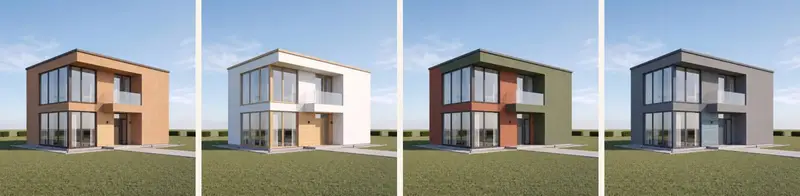
Exterior colour combination for house with white
White works best as a warm off-white, not a stark blue-white, with a darker plinth and window sills. Pure white on every surface looks sharp for one season, then shows every rain streak below the parapet. Pair it with wood tones, brick or a mid-grey band at the base.
Indian-style exterior colour combinations
For an Indian-style front, lean on earth colours: terracotta, ochre, sandstone, deep red and cream, often with wood or stone. They suit jaali screens, sloped tiled roofs and courtyards, and most of them hide dust far better than modern whites and greys.
Does exterior colour change how hot the house gets?
Yes. Light, reflective surfaces absorb less solar heat than dark ones. The Bureau of Energy Efficiency's Energy Conservation Building Code 2017 defines a cool roof as having "high solar reflectance and high thermal emittance properties" and says "Cool roof surfaces are characterized by light colors so that heat can be rejected back to the environment." Its clause 4.3.1.1 asks low-slope cool roofs (under 20°) for an initial solar reflectance of no less than 0.70 and emittance of no less than 0.75.
Be clear about the limits of that source. The ECBC is written for commercial buildings, and the cool-surface rule is for roofs, not walls. BEE's residential code, Eco-Niwas Samhita 2024, explains solar reflectance on a scale of 0 to 1, where 0 absorbs all incident solar radiation and 1 reflects all of it. The physics is the same on a west-facing wall, but on a wall, shading and insulation usually matter more than paint.
Paint makers say the same about colour. Resene's guide to light reflectance values notes that "Surfaces low in light reflectance value are generally very dark and can get very hot", and that colours with high light reflectance values such as white "will generally last longer than darker colours".
What we would do: keep the big west and south walls light, and use darker colours on smaller, shaded elements.
What is LRV and how do you use it?
LRV, or light reflectance value, is the percentage of visible light a colour reflects. Resene describes it as the proportion of light a surface reflects compared with the light falling on it, with black at 0% and white at nearly 100%.
Use it two ways. First, as a quick check on heat and fading: a body colour with a high LRV will stay cooler and last longer than one with a low LRV. Second, for contrast: if the body and trim have similar LRVs, the trims vanish from the street. Aim for a clear gap.
One caution. LRV measures visible light, while heat comes from the whole solar spectrum, including infrared. That is why some makers sell "cool" colours; Resene says its CoolColour range reflects "the same visible light as a standard colour but reflect significantly more heat." So a dark colour that is sold as solar-reflective may run cooler than its LRV suggests. Ask for the product's technical data, not the brochure.
How should you split colours on a front elevation?
Use roughly 60% body colour, 30% secondary colour and 10% accent. The body covers the main walls, the secondary goes on bands, the plinth, the parapet or a feature wall, and the accent goes on the door, a jaali or the railing.
Here is a worked example for an illustrative G+1 on a 30×40 plot, with a front face of about 26 ft wide and 22 ft tall, so about 572 sq ft before openings:
| Role | Share | Area (approx.) | Where it goes | Example family |
|---|---|---|---|---|
| Body | 60% | ~340 sq ft | Main wall planes of both floors | Warm off-white |
| Secondary | 30% | ~170 sq ft | Plinth band, staircase tower, parapet band | Warm mid-grey |
| Accent | 10% | ~57 sq ft | Main door, window frames, one jaali panel | Teak wood tone |
Two rules make the split work in India. Put the darker of your colours at the bottom, on the plinth and the first two feet of wall, where rain splash and road dust land. And give every sill and ledge a darker or easy-clean colour, because that is where streaks start.
If you are still building, decide the colour scheme along with the elevation, before the plaster. Our guide to house construction stages shows where that decision fits in the sequence.
How do you test an exterior colour before you buy?
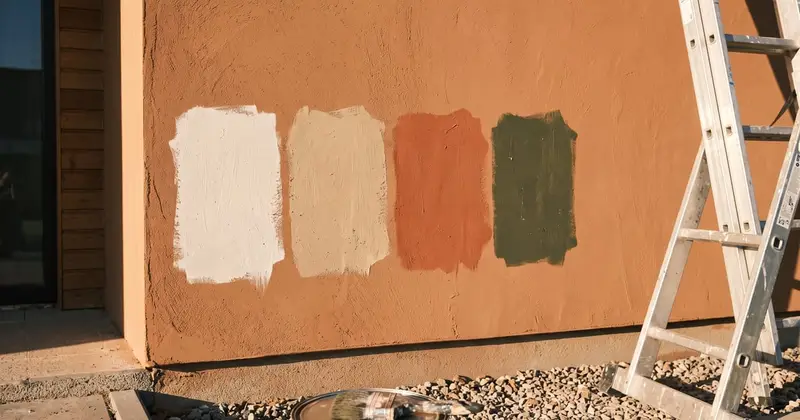
Paint a sample patch on the actual wall and judge it outdoors, at different times, from the street. Here is the checklist we would follow.
- Shortlist two or three shades in one family from a physical fan deck, in daylight.
- Buy sample packs and paint patches of at least 2 ft × 2 ft on two walls: the main front and a side that faces a different direction.
- Look at them around 9 am and again around 4 pm. Indian sun is harsh; a soft cream at noon can look almost white.
- Step across the road. Colour looks lighter and brighter on a large wall seen from a distance.
- Look at the neighbours. A house that fights the whole lane looks louder than you planned.
- Check the roof, the stone and the tiles you already have. The paint has to sit with them.
- Confirm the plinth and sills are darker or washable.
- Decide after the patches have dried for a day, not while wet.
What paint system should you use outside?
Use an exterior-grade system from primer to topcoat on fully cured plaster, and follow the manufacturer's data sheet.
Asian Paints' product sheet for Apex Ultima Protek, an elastomeric exterior system, is a good example of what to look for in any brand's sheet:
- Curing time. It recommends allowing 28 days as the curing time for new masonry before painting.
- Monsoon timing. It says a primer coat or a single topcoat should not be left exposed in the monsoon, and that before the monsoon, horizontal surfaces should be coated first and then vertical, to reduce algal streak marks.
- Cracks. It claims crack bridging of up to 2 mm at 200 microns, which is the point of an elastomeric coat on Indian plaster.
- Upkeep. It advises washing the painted surface and cleaning algae and fungus every six months.
Filler matters too. Use a putty the maker rates for exterior use; Asian Paints' TruCare Wall Putty sheet, for instance, lists both interior and exterior plaster, but not every putty sold does. Read the sheet before the painter starts, not after the first rain.
Can you try a front elevation colour combination online with AI?
Yes, and it is the fastest way to narrow twelve options to two. Take a straight, eye-level photo of your house in soft daylight, then try colour families on that photo rather than on someone else's house.
We built Edit & Swap for exactly this kind of change: you describe the part you want changed, such as "paint the main walls warm off-white and the plinth band mid-grey", and the rest of the image stays as it was. If the house is still on paper, Exterior Rendering takes your 2D elevation or a SketchUp view and returns a photoreal front that keeps your windows and floor heights, so you can compare palettes on the real design.
The limits are real. A screen is not paint: brightness, the camera and the AI all shift colour, so never order paint from a render. Use AI to choose the family and the split, then patch-test the actual shades. For the materials side of a facade, brick, stone, jaali or cladding, see our post on AI facade design for houses. If you want a designer to produce the final 3D elevation, our guide to 3D elevation design cost in India explains what a fair package includes.
FAQ
Which exterior colour combination for house fronts is best in India?
For most Indian houses, a light warm body colour such as off-white, cream or sand, with a darker plinth and sills and one accent near the entrance, works best. It stays cooler, hides dust where dust lands, and ages well through the monsoon. Earth combinations like terracotta with off-white suit traditional and courtyard houses.
Do light colours really keep a house cooler?
Light, high-reflectance surfaces absorb less solar heat than dark ones. BEE's Energy Conservation Building Code 2017 describes cool roofs as light-coloured so that heat is rejected back to the environment. That rule is written for roofs; on walls, shading and insulation usually matter more, but keeping large sun-facing walls light still helps.
What is a good LRV for exterior walls?
There is no single official number for Indian homes. Choose a body colour with a high LRV for large sun-facing walls, because high-LRV colours absorb less light and, according to paint maker Resene, generally last longer than darker ones. Keep a clear LRV gap between body and trims so the details read from the street.
How many colours should I use on the front of my house?
Two or three is enough: a body colour, a secondary colour and one accent, split roughly 60-30-10. More than that usually looks busy on a typical 30×40 or 30×50 front. Natural materials such as wood, stone or brick count as one of the colours, so plan them into the split.
Can I see exterior colours on my own house before painting?
Yes. Photograph your house straight on in daylight and try colour families on the photo with an AI tool such as Velocity AOI's Edit & Swap, which changes only the part you describe. Then paint real sample patches and check them at 9 am and 4 pm, because screens never match paint exactly.
Choose the colour for year three
Shortlist one family, split it 60-30-10, darken the plinth and sills, and patch-test before you buy. If you want to see the options on your own house first, upload a photo or your elevation on Velocity AOI.
Sources

Written by
Velocity Team
Architecture and design team at Velocity AOI
We write plain guides for Indian home-owners and the architects they hire. Every number links to its source, and images made with AI are labelled.