


Architect Fees in India (2026): COA Scale, Stages and Real Maths
Architect fees in India explained from the Council of Architecture's own documents: the 7.5% scale for houses, the 2022 manual's newer table, the stage-wise payment schedule, a worked example on a 2,000 sq ft G+1, GST and a contract checklist.

Written by Velocity Team
Architecture and design team at Velocity AOI
Published
Updated
Reading time
11 min
On this page10 sections · 11 min read
- Key takeaways
- How much do architects charge in India?
- COA stage-wise fee schedule (table)
- Is the COA scale of charges mandatory?
- How do architects charge in India: percentage, per sq ft or lump sum?
- A worked example: 2,000 sq ft G+1 house
- What is included in an architect's fee, and what is extra?
- Contract checklist before you sign
- How should a young architect set their fee?
- FAQ
Architect fees in India are usually charged as a percentage of construction cost, a rate per sq ft, or a fixed lump sum. The Council of Architecture's published scale sets 7.5% of the cost of works for an individual house with comprehensive services, and its 2022 manual gives 6.65% to 8.55% for a single dwelling under ₹4.9 crore. GST at 18% comes on top.
Those numbers only help if you know what they cover. Below is the official COA text, a worked example on a real-sized house, and what to settle before you sign.
Key takeaways
- COA scale: 7.5% of the cost of works for an individual house, comprehensive services. Interiors and landscape are charged separately.
- COA manual (2022): 6.65% to 8.55% for a single dwelling under ₹4.9 crore including structural and MEP design, or 3.86% to 4.96% for architecture alone.
- Payment runs in stages, from a retainer to 100% at completion, plus 10% documentation charges and 18% GST.
- No ruling we could find settles whether the scale is a legal floor. Treat it as the profession's benchmark.
How much do architects charge in India?
For a house, most architects charge between a few per cent and about 8.5% of construction cost, depending on whether structural, plumbing and electrical design is included. Of all the figures online, only the COA's come from the profession's regulator.
There are two COA sources, and they do not match exactly. One is the COA Scale of Charges, still published on coa.gov.in. Another is Volume 4 of the Manual of Architectural Practice, "Guidelines for Architectural Services & Fees" (2022), which calls itself "an updated version of Conditions of Engagement and Scale of Charges approved by the Council in the year 2002".
| Project or service | COA Scale of Charges | COA Manual Vol. 4 (2022) |
|---|---|---|
| Individual house, comprehensive | 7.5% on the cost of works assigned | 6.65% simple / 8.55% complex (under ₹4.9 crore) |
| Individual house, architecture only | Not listed | 3.86% simple / 4.96% complex |
| Interior design | 7.5% | 9.00% simple / 10.00% complex (under ₹9.9 crore) |
| Landscape | 7.5% | 6.50% simple / 7.00% complex |
| Additions and alterations | 7.5% | 7.50% simple / 8.50% complex |
| Documentation and communication | 10 percent of the professional fees | Not in the fee table |
In the manual, "comprehensive" means architecture plus basic structural, MEPF and liaisoning, on gross construction cost, and these "are Net fees, and any applicable taxes are excluded". A simple project has an easy site and plain finishes; a complex one has a hard site or a brief that "calls for remarkable character and complexity".
One note on the older scale matters for small jobs: "For works costing upto Rs. 1400 M the professional fees may be negotiable". Since "The current value of M is 1000", that means work up to ₹14 lakh, which covers many flat renovations.
COA stage-wise fee schedule (table)
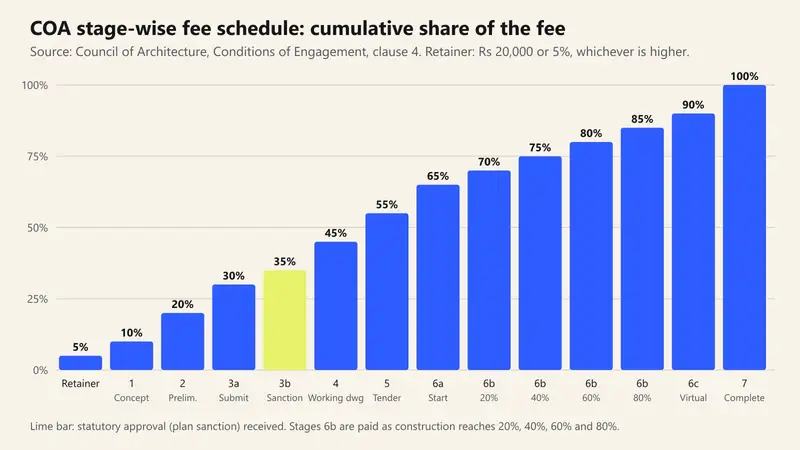
COA terms do not expect you to pay everything at the end. Its Conditions of Engagement for Comprehensive Architectural Services tie each instalment to a stage. Percentages are cumulative.
| Stage | When it is due (shortened) | Cumulative share of total fee |
|---|---|---|
| Retainer | On signing the agreement | Rs. 20,000 or 5% of total fees, whichever is higher, adjusted at the last stage |
| Stage 1 | Concept design and rough cost estimate | 10% |
| Stage 2 | Preliminary scheme with preliminary estimate | 20% |
| Stage 3a | Drawings submitted for client / statutory approval | 30% |
| Stage 3b | Statutory approval received | 35% |
| Stage 4 | Working drawings, specifications, quantities, tender documents | 45% |
| Stage 5 | Tenders analysed, contractor advice | 55% |
| Stage 6a | Drawings for commencement of work | 65% |
| Stage 6b | At 20%, 40%, 60%, 80% of work done | 70%, 75%, 80%, 85% |
| Stage 6c | Virtual completion | 90% |
| Stage 7 | Completion report, as-built drawings | 100%, less payments made and the retainer |
11 rows in this table
Source: Council of Architecture, Comprehensive Architectural Services, clause 4. The retainer is printed as "Rs. 20M"; the Scale of Charges page defines M as 1000.*
Three clauses catch clients out. Clause 5.1 says the fee "shall be computed on the actual cost of works on completion", so a budget that grows from ₹50 lakh to ₹65 lakh grows the fee too. Clause 5.5 excludes land cost. Clause 9.09 charges revisions to approved drawings at 50% of the fee for that stage. Our post on design approval stages and sign-off shows how to use those gates calmly.
Is the COA scale of charges mandatory?
COA regulations tell architects to follow it, but we could not find a court judgment, Competition Commission order or COA notification that settles whether it works as an enforceable minimum price today.
What the text says is clear. The Architects (Professional Conduct) Regulations, 1989 require an architect in private practice to "inform his Client of the conditions of engagement and scale of charges and agree that these conditions shall be the basis of the appointment" (2(1)(iv)) and to "observe and uphold the Council's conditions of engagement and scale of charges" (2(1)(xii)). Regulation 2(3) makes a violation "professional mis-conduct". On the scale page, the fee column is headed "Minimum fees".
By contrast, the 2022 manual says the COA "advises" firms to use "the scale of minimum fees", and that higher fees "may be charged with the Client's prior agreement". So the rule governs the architect's conduct. It does not tell you, the client, what to pay, and you will see quotes on both sides of it. We are not lawyers; if a dispute turns serious, get your contract read by one.
How do architects charge in India: percentage, per sq ft or lump sum?
Three models dominate, and the COA manual recognises all of them plus hourly billing. Each shifts risk differently.
Percentage of construction cost. Fair when the scope runs from concept to completion. The catch: an architect who specifies Italian marble raises their own fee, so fix a budget at Stage 1.
Per sq ft. Easy to compare, common for interiors and small houses. Built-up, carpet and plot area differ a lot on a G+1, so always ask "per sq ft of what?"
Lump sum. One fixed number for a written scope. In the manual's view it suits "small/compact projects when the project specifics and scope of services are known". A vague lump sum ends in arguments about what was included.
A worked example: 2,000 sq ft G+1 house
Say you are building a 2,000 sq ft G+1 on a 30×40 plot in Bengaluru. For the arithmetic, assume construction at ₹2,500 per sq ft, so ₹50 lakh. That is a round number for the sum, not a market rate; check it against published house construction rates per sq ft and your contractor's or quantity surveyor's estimate.
- COA scale, 7.5%: ₹50,00,000 × 7.5% = ₹3,75,000.
- Documentation charges, 10% of fee: ₹37,500. Subtotal ₹4,12,500.
- GST at 18%: ₹74,250. Total about ₹4,86,750.
- 2022 manual, simple project: 6.65% comprehensive = ₹3,32,500, or 3.86% architecture only = ₹1,93,000 (structural and MEP consultants then paid separately).
- Per sq ft: at a quoted ₹150 per sq ft of built-up area, 2,000 × ₹150 = ₹3,00,000. Divided by the construction rate, ₹150 ÷ ₹2,500 = 6%.
- Lump sum: a fixed ₹3,50,000. Compare it with the lines above, then read what the scope leaves out.
Step 5 is the trick worth keeping. Once you know the construction rate, any per-sq-ft quote converts to a percentage and back. Here, 7.5% equals ₹187.50 per sq ft of construction.
On the stage table, this fee means a ₹20,000 retainer, cumulative ₹37,500 at concept, ₹1,31,250 once sanction comes through, and ₹1,68,750 at working drawings. Later numbers move with the actual cost.
What is included in an architect's fee, and what is extra?
COA's comprehensive scope includes the brief, site evaluation, design, structural, plumbing, electrical, HVAC and fire design, and periodic inspection. Interiors, landscape and graphics are "allied fields" with their own fee.
| Item | Inside a comprehensive fee? | COA reference |
|---|---|---|
| Concept to working drawings | Yes | Stages 1 to 4 |
| Structural, plumbing, electrical design | Yes; not in "architecture only" | Scope of Work, Part I |
| Interior design | No | Part II, allied field |
| Day-to-day site supervision | No | Supervisor "appointed and paid by the Client" (2.14) |
| Site visits | Reimbursed | Local visit Rs. 1M, outstation day Rs. 3M plus travel |
| Survey, soil test, sanction fees | No | Client pays (8.03, 8.04, 8.06) |
| Presentation models, computer simulation | Reimbursable if not for design and execution | Clause 7.02 |
That last row covers most 3D views made for presentation, such as a set for the family or a loan file. For a standalone 3D front, see our breakdown of 3D elevation design cost in India.
On GST: architectural services fall under heading 9983 at 18% (9% CGST plus 9% SGST), under entry 21 of Notification 11/2017-Central Tax (Rate), as quoted in this advance ruling published by the GST Council. Clause 3.02 of the COA conditions puts tax on the client, "over and above the gross fees". A practice not registered for GST will not add it, so ask.
Contract checklist before you sign
Check these before you pay the retainer. If a line is missing, ask for it in writing.
- Fee model, and for per sq ft, which area
- Cost base: estimate, tender cost or actual cost on completion
- Whether structural, MEP and interiors are inside the fee
- Stage-wise payments tied to deliverables you can see
- Design options and revision rounds per stage, and the charge after approval
- Site visits included, and the rate for extra visits
- Documentation charges, reimbursables and GST shown separately
- Termination terms (COA conditions require 30 days' written notice)
Red flags: a full design shown before any agreement (regulation 2(1)(xiv) bars designing in competition without payment), someone not on the COA register calling themselves an architect, a fee with no written scope, and "commission" offered from the contractor's side.
How should a young architect set their fee?
Start from your costs, not the lowest quote in town. Add up monthly overheads, estimate the hours a G+1 really takes you per stage, and check that the COA percentage covers them with a margin. The 2022 manual recommends keeping your own data on hours per stage and fee per area for exactly this.
Then make the fee easy to accept. Quote a percentage, the rupee figure for their budget and the per-sq-ft equivalent side by side, and tie payments to COA stages. Write revision rounds into the agreement.
Visuals protect your hours. A client who sees three facade options at concept stage decides faster; we built Velocity's tools for that stage, and our page for architects using Velocity lists them by task. A render is still a picture of intent, not a working drawing. If you are still finding clients to quote to, read our guide on how to get clients as an architect in India.
FAQ
What is the COA scale of charges for a house?
COA's Scale of Charges on coa.gov.in lists 7.5% on the cost of works assigned for an individual house, for comprehensive architectural services including site development. Interiors and landscape are charged separately. Its 2022 manual gives 6.65% to 8.55% for an independent single dwelling under ₹4.9 crore, including basic structural and MEP design.
How much do architects charge per square foot in India?
No official per-sq-ft rate exists; the COA works in percentages. To compare a per-sq-ft quote, divide it by your construction cost per sq ft. At ₹2,500 per sq ft of construction, a fee of ₹150 per sq ft equals 6%. Always confirm whether the rate applies to built-up, carpet or plot area.
Is GST charged on architect fees in India?
Yes, if the architect is registered for GST. Architectural services fall under heading 9983 and attract 18% GST, split as 9% CGST and 9% SGST. COA's conditions of engagement make tax payable by the client over and above the fee. Ask for GST as a separate line on every invoice.
Can I pay my architect less than the COA scale?
Those regulations bind the architect, not you. An architect must observe the COA's conditions and scale of charges, and a breach can be treated as misconduct, but we found no ruling that makes the scale a legal floor. Quotes vary widely, so compare like with like. Negotiate scope rather than squeezing the percentage.
What does an architect's fee usually not include?
Under the COA conditions, interior design, landscape, day-to-day site supervision, soil tests, surveys, sanction fees and travel for site visits sit outside the main fee; for what the interiors themselves cost, see our guide to interior design cost per sq ft with a 2BHK worked example. With an "architecture only" appointment, structural, plumbing and electrical design are extra too. Get every exclusion listed in writing before you sign.
Get the fee agreed, then get the design right while changes are still cheap. To see options for a facade, a room or a whole house before working drawings are frozen, start at Velocity AOI.
Sources

Written by
Velocity Team
Architecture and design team at Velocity AOI
We write plain guides for Indian home-owners and the architects they hire. Every number links to its source, and images made with AI are labelled.